
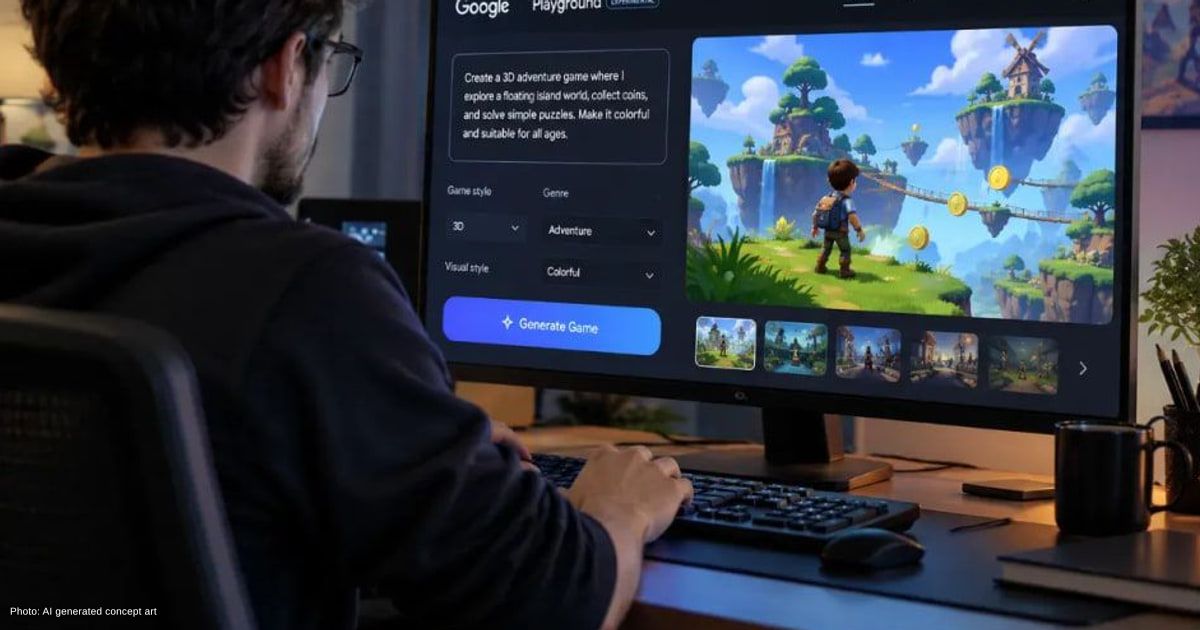
Google and Unity Team Up to Let Anyone Create Video Games Using AI Prompts
Creating a video game usually takes programming knowledge, design skills and plenty of time. However, artificial intelligence is beginning to change how people approach the process. New tools are making it possible to turn simple ideas into playable experiences without writing code. Google and Unity are now taking that concept further through a partnership that could change how people create and share interactive entertainment.
Key Takeaways
Google and Unity are partnering to create an AI-powered platform called Playground, enabling users to generate games using natural language prompts, with plans for a more advanced tool, Unity Spark, to foster accessible and high-quality game development.
- Google and Unity’s new experimental platform, Playground, allows users to create playable games using AI and natural-language prompts, lowering the barrier to entry for aspiring game developers.
- Unity plans to launch Unity Spark later this year, integrating with Playground to offer professional-level tools for sophisticated mechanics and high-quality 3D experiences, with potential future expansion to consoles.
- The partnership aims to produce genuine interactive entertainment rather than low-quality content, and includes planned community features like leaderboards and multiplayer matchmaking to connect creators with players.
Creating games with AI
Google and Unity announced their partnership on October 7, introducing an experimental platform called Playground. The service allows users aged 18 and older to generate and customise playable games through natural-language prompts.
Rather than learning programming languages, creators can describe what they want and let AI handle much of the technical work. This approach could make game development more accessible to people who have never built a game before.
Later this year, Unity plans to introduce Unity Spark, a more advanced creation platform integrated with Playground. Its professional-level tools will support sophisticated mechanics and high-quality 3D experiences.
Console support planned
Unity CEO Matthew Bromberg believes the technology could eventually reach consoles, although nothing has been confirmed. During an interview with CNBC, he explained that Unity has traditionally allowed developers to build games once and distribute them across multiple platforms.
Initially, Unity Spark will focus on web-based creation before expanding to mobile devices. Bromberg hopes the technology will eventually support other platforms, including consoles. Such expansion could make AI-assisted gaming more accessible while giving independent creators additional ways to reach players.
Avoiding low-quality content
Despite the excitement surrounding AI, Bromberg wants Unity Spark to offer more than quickly generated games. His goal is to help users produce genuine interactive entertainment rather than what he described as “AI slop.” Building a complete game involves several disciplines, including level design, sound, interfaces and backend systems. Unity hopes AI can simplify these processes without sacrificing quality.
Meanwhile, Google Playground will serve as an entry point for beginners, with Unity Spark providing a path towards more advanced projects. Planned community features include Google Play Games profiles, leaderboards and multiplayer matchmaking, allowing creators to connect with players. These additions reflect broader gaming trends that combine accessible creation tools with social experiences.
Competition heats up
The announcement has attracted attention from investors, particularly because Roblox already allows users to create and share their own games. Unity shares initially climbed nearly 6% in premarket trading before losing momentum later in the session. Roblox also experienced early selling pressure, although its shares subsequently recovered.
Analysts believe the partnership could expand Unity’s creator base without necessarily threatening Roblox’s established social platform. Still, Unity faces financial challenges, including ongoing losses and concerns about its valuation.
As gaming industry innovations continue to emerge, the partnership could introduce millions of potential creators to interactive experiences previously requiring specialist skills. Its success will depend on whether those creators can turn simple prompts into games people genuinely want to play.

Marcus Kade
Marcus Kade is Managing Editor at Spiel Times, covering breaking gaming news with a focus on the industry's business side. When not writing, he's probably losing a co-op game to his partner.
View all articlesRelated Articles
View All
Football Manager 27 Unveils a Smarter Interface With Fewer Clicks
Sports Interactive has revealed early details about Football Manager 27’s interface improvements ahead of its November 2026 launch, introducing changes...
Where To Buy Aion 2 Kinah Safely? A Complete Guide
AION 2 has officially arrived, bringing a new generation of MMORPG adventure to players around the world. After years of...
Gaming Trends Lean Into Easier Access, Community, and More Choice
Gaming in 2026 is becoming easier to enter without losing ambition. Newzoo forecasts a $213.9 billion global games market this...